Mental Capacity Act
In the UK, mental health guidelines and mental capacity guidelines are primarily there to protect people's rights while ensuring they receive appropriate care and support.
Mental health
Mental health guidance helps professionals:
Assess and diagnose mental health conditions.
Decide on suitable treatment and support.
Manage risks where someone may be at risk of harming themselves or others.
Ensure care is delivered consistently and according to best practice.
Key frameworks include:
National Institute for Health and Care Excellence guidelines for treatment and care.
Mental Health Act 1983 (as amended), which governs when someone can be assessed, detained, and treated for a mental disorder without their consent in certain circumstances.
Mental capacity
Mental capacity concerns whether someone can make a particular decision for themselves.
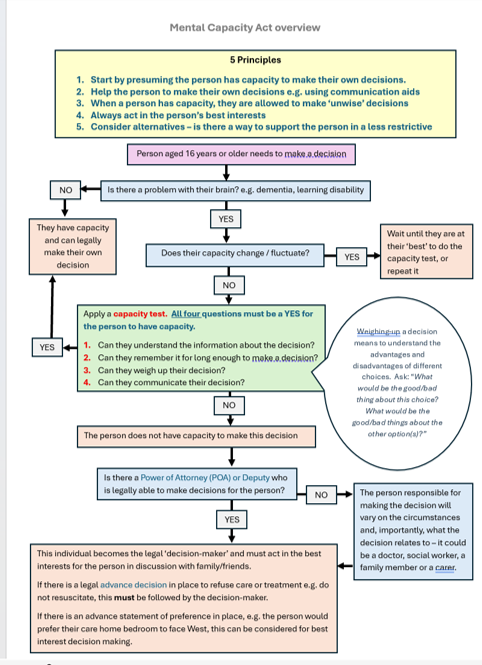
The main law is the Mental Capacity Act 2005, which is built around five key principles:
Presume capacity unless proven otherwise.
Provide support to help the person make their own decision.
Respect unwise decisions—making a decision others disagree with does not mean a person lacks capacity.
If a person lacks capacity, any decision made for them must be in their best interests.
Choose the least restrictive option possible.
A person is considered unable to make a specific decision if they cannot:
Understand relevant information.
Retain that information long enough to decide.
Use or weigh the information as part of the decision-making process.
Communicate their decision.
Why these guidelines matter
They are used daily by:
Doctors and nurses.
Social workers.
Care homes.
Hospitals.
Local authorities.
Courts.
For example, if an elderly person with dementia refuses care, professionals may need to assess whether they have capacity to make that particular decision. If they do, their choice must generally be respected. If they do not, decisions may be made in their best interests under the Mental Capacity Act.
Similarly, if someone is experiencing a severe mental health crisis and poses a serious risk, the Mental Health Act may allow assessment or treatment without consent, even if they have capacity.
If you have a specific situation in mind—such as social services, a capacity assessment, hospital discharge, Power of Attorney, or care-home placement—I can explain how the rules apply in practice.
Attached is an easy to understand flowchart and the 5 principles - Download here